The Complete Evening Wind Down Routine for Better Sleep
A research-backed evening wind down routine for adults. Writing a to-do list before bed cuts sleep onset by 9 minutes (Scullin, 2018). Here's the full sequence.
I was trying to fall asleep with a racing mind and twelve tabs open
For years my "wind down routine" was Netflix, phone in hand, finishing work emails from bed, lights overhead, room too warm, one last scroll before I forced myself to close my eyes. Then I would lie there for 45 minutes wondering why I could not sleep.
The answer turned out to be obvious. I was trying to sleep the way I tried to work. Fast, bright, stimulated, and on.
Fixing the last hour of my day fixed more than my sleep. It fixed my mornings, my mood, and my focus during the day. This post is what I changed, in the order I changed it, and what the research actually says about why a real evening wind down routine makes a measurable difference.
TL;DR
- A wind down routine is a deliberate 60 to 90 minute transition between wakefulness and sleep, not just "getting ready for bed"
- Matthew Walker's research on sleep, summarised in 'Why We Sleep,' shows that consistent pre-sleep routines significantly reduce sleep onset and improve sleep quality
- Five layers to work on: light, temperature, screens, body, and mind
- The 3-2-1 rule is a useful heuristic: no caffeine 8-10 hours before bed, no screens 1 hour before, no heavy food 2-3 hours before
- Michael Scullin's Baylor research showed that writing a next-day to-do list reduced sleep onset by roughly nine minutes, which is a big effect from a two-minute habit
- Start small. Twenty minutes of deliberate wind down every night beats a perfect 90-minute routine you do twice
- The routine is a signal to your nervous system, not a ritual. Consistency matters more than any individual step
Why Does the Last Hour Before Bed Determine How You Sleep?
Sleep is not a switch. Your nervous system does not flip from "awake and working" to "asleep" at the moment your head hits the pillow. The transition takes time, and the quality of that transition determines how quickly you fall asleep, how long you stay asleep, and how rested you feel in the morning.
The mechanisms are biological. Your core body temperature needs to drop by roughly one degree Celsius for sleep to initiate. Melatonin release needs to ramp up, which happens in response to reduced light exposure. Cortisol needs to fall from its daytime peak, which is tied to activity level and stress state. The parasympathetic nervous system needs to take over from the sympathetic, which controls whether you are in "rest and digest" mode or "fight or flight" mode.
All of this takes time. If you give the body none, it does the transition while you are lying in bed trying to sleep, and that is what lying awake for 45 minutes actually is. Your body doing in bed what it should have done over the preceding hour.
Matthew Walker, a neuroscientist at UC Berkeley and author of the widely cited book 'Why We Sleep,' has argued repeatedly that the pre-sleep period is one of the most under-leveraged tools for sleep quality. His consistent message: a deliberate, repeatable wind-down routine does more for most people's sleep than any supplement, mattress, or tracking device.
What Are the Five Layers of a Wind-Down Routine That Works?
This is the version that works. Pick one or two layers to start with, not all five at once.
Layer 1: Light
Bright light suppresses melatonin. Blue and cool-toned light suppresses it more. For the last hour before bed, dim everything.
Specific actions:
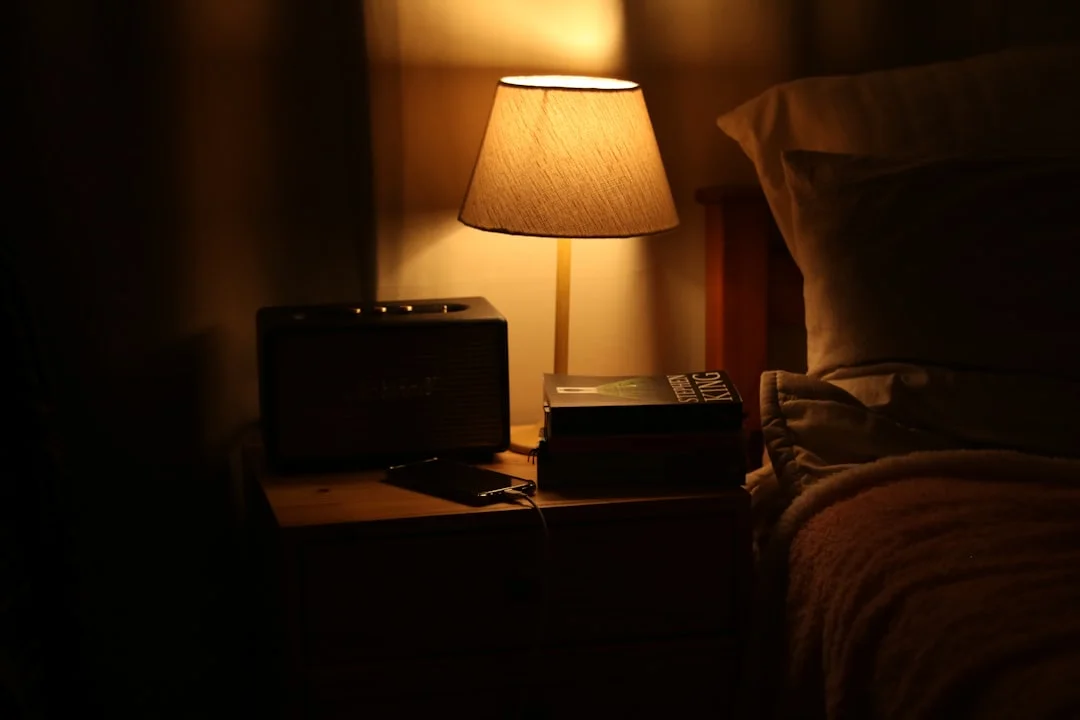
- Turn off overhead lights. Use lamps with warm bulbs (2700K or lower) instead.
- Set your phone and laptop to warm night-mode automatically after 9pm.
- If you still watch TV, lower the brightness. Most TVs are set far brighter than they need to be in the evening.
- Use blackout curtains or an eye mask. Stray streetlight during sleep interferes with melatonin cycling even with your eyes closed.
If you do only one thing from this list, switch off the overhead lights. It is the single biggest light-related lever you have.
Layer 2: Temperature
The body's core temperature naturally drops about one degree as sleep approaches. You can support this or work against it.
- Bedroom around 16 to 19 degrees Celsius (60 to 67 Fahrenheit). Colder than most people keep their living rooms.
- A warm shower or bath 60 to 90 minutes before bed. Counterintuitively, warming then cooling helps the drop by bringing blood to the surface and then dissipating heat faster.
- Avoid heavy blankets that trap too much heat. Breathable layers you can adjust are better than maximum insulation.
Layer 3: Screens
This is the layer most people resist most and need most.
The issue is not just the blue light, although that matters. It is the cognitive activation. Scrolling, reading work emails, watching something dramatic, or checking news all put the brain back into active processing mode. You cannot easily wind down while you are consuming content designed to keep your attention.
Practical version:
- Phone goes on the charger in another room at least 30 minutes before bed, or in a drawer if that is not possible.
- No email after 8pm. If you cannot honour this, it is a separate problem worth addressing.
- No news or social media in the last hour. Not even "just a quick check."
- A paper book is the best bedtime reading. If you need an ebook, use a Kindle or other e-ink device, not a phone or tablet.
If a full screen fast feels impossible, the compromise that works is moving to a dedicated device for the last hour. A Kindle for reading. A single music playlist on a speaker. Anything that is not the infinite feed of your phone.
Layer 4: Body
Gentle movement helps. Intense movement hurts.
- Stretching for five to ten minutes, slowly. Focus on the hips, shoulders, and lower back.
- A short walk around the block is excellent in warmer weather. Fresh air plus light movement plus reduced artificial light.
- Yoga Nidra or a simple body scan works for people who want something more structured.
- Avoid heavy workouts in the last two hours before bed. They raise core temperature and cortisol in ways that directly fight what you are trying to do.
Caffeine deserves a mention here. The half-life of caffeine is five to six hours for most adults, which means a 2pm coffee is still significantly active at 10pm. If you struggle to wind down, check your afternoon caffeine before you blame your routine.
Layer 5: Mind
This is where journaling earns its keep, and where the research is strongest.
Michael Scullin and colleagues at Baylor University published a study in the Journal of Experimental Psychology: General showing that participants who wrote a specific to-do list for the next day fell asleep roughly nine minutes faster than those who wrote about completed tasks. That is a meaningful effect from about two minutes of writing.
The mechanism is the Zeigarnik effect. The brain fixates on unfinished tasks and keeps rehearsing them until it feels they are safely captured. Writing them down gives the brain permission to let go.
A practical five-minute mind wind-down:
- Tomorrow's three most important things, written as concrete actions, not "work on the report."
- Two things you are still thinking about from today. Just capture them, do not solve them.
- One thing you are grateful for, specific, from the last 24 hours.
This is close to the night journaling practice, and for most people the overlap is useful. Five minutes, three lists, book closed. If you want deeper reflection, pair it with the weekly bullet journal review. Daily wind-down does not need to go deep.
What Is the 3-2-1 Rule and Why Does a Simple System Help?
The 3-2-1 rule is a simple version of all of the above:
- 3 hours before bed: no heavy food or alcohol
- 2 hours before bed: no more caffeine (though most people need to stop earlier)
- 1 hour before bed: no screens
Other versions exist. 10-3-2-1-0 adds 10 hours without caffeine, 3 hours without food, 2 hours without work, 1 hour without screens, and 0 snooze hits in the morning. The specific numbers matter less than the underlying principle: give the body time to wind down before you ask it to sleep.
The heuristics are useful because they are memorable. "No screens after 10pm" is a rule you can actually follow. "Optimise your circadian rhythm" is not. Pick a version, stick to it for two weeks, adjust if needed.
What Does a Realistic 60-Minute Wind-Down Actually Look Like?
The version I actually use. Feel free to copy.
60 minutes before bed: switch off overhead lights, kitchen light only. Start dimming the house.
45 minutes before: shower or bath. Change into whatever I sleep in. Brush teeth. Skincare.
30 minutes before: phone goes on the charger in the living room. Kindle or a paper book in bed.
20 minutes before: read. No news, no work-adjacent content, fiction or memoir preferred.
10 minutes before: put the book down. Two minutes of stretching. Climb into bed.
5 minutes before lights off: quick journal entry, three tomorrow-priorities, one gratitude note. Book closed. Lamp off.
That is the whole thing. Six steps, about an hour, zero heroics. The specific steps are less important than doing the same sequence every night. Your nervous system learns the pattern and starts winding down at the start of the sequence rather than having to be forced down at the end.
What Do You Do When the Routine Stops Working?
If you are doing everything above and still struggling, check three things before changing the routine.
Caffeine. Most people underestimate how long coffee stays active. Try cutting afternoon caffeine entirely for a week.
Alcohol. A glass of wine helps you fall asleep but destroys the deep sleep phase in the second half of the night. If you drink most evenings and feel unrested, that is a strong candidate for the cause.
Anxiety. If racing thoughts are the block, the five-minute brain dump is the most effective tool you have. Our post on journaling for anxiety and overthinking covers specific techniques for breaking the rumination loop.
Where Mindful fits in
Mindful is built to handle the five-minute mind wind-down portion. A quick three-step prompt for tomorrow's priorities, today's loose ends, and one gratitude note, done in under three minutes. The app closes with a soft screen and stops prompting.
Pair it with the analogue steps (lights, temperature, screens, body) and the combination is the routine. The journaling takes two to three minutes. Everything else is environment.
It is free to start, and the evening check-in is one of the simpler features to adopt if you are already trying to build a wind-down habit.
Start with the last 20 minutes
If the full hour sounds ambitious, start small. For the last 20 minutes of your day, do three things: dim the lights, put the phone on the charger, write three lines.
That is the whole starting point. Two weeks of consistency will do more than two months of ambitious but sporadic attempts. Once the 20 minutes is automatic, stretch it to 40. Once 40 is automatic, you have the full routine without having forced it.
The goal is not a perfect ritual. The goal is a nervous system that knows the day is ending. Give it the signal. It takes the cue from there.
Free to use, no credit card needed
Try Mindful free →