Bullet Journal for Mental Health: 8 Essential Layouts
How to use a bullet journal for mental health. Eight research-backed layouts covering mood, anxiety, sleep, and the brain dump that actually clears your head.
My first bullet journal was beautiful and mostly useless
I bought the dotted notebook, the Tombow brush pens, the washi tape. I spent three hours on the first monthly spread alone. I hand-lettered the word "April" in two styles before deciding which one was right. I colour-matched a mood tracker. I was very proud.
By week two I was avoiding it. The spreads were too precious to mark up, so I started skipping entries rather than ruining the aesthetics. By week four the journal sat closed on my desk, a monument to the gap between Instagram bullet journaling and the kind that actually does something.
The version that works for me now is ugly. One plain notebook. A Pilot G2 pen. Messy handwriting. And it has done more for my mental health than every beautiful spread combined.
This post is what I wish someone had told me before the Tombow phase.
TL;DR
- Bullet journaling for mental health works through offloading, externalising mental clutter onto the page so your brain can let go of it
- The system was developed by Ryder Carroll, who built it while managing ADHD and anxiety. His method prioritises function over aesthetics
- Eight specific spreads cover most mental health use cases: mood tracker, habit tracker, brain dump, gratitude log, thought record, trigger log, sleep tracker, and weekly review
- Keep spreads simple. Instagram-perfect bullet journals are often abandoned within a month because the maintenance cost becomes the problem
- Mueller and Oppenheimer's Princeton research found handwriting engages processing differently from typing, which gives paper bullet journaling specific cognitive advantages for reflection
- Two weeks of consistent use is enough to see whether it fits your life
Why Does a Paper Bullet Journal Work When Apps Don't?
The bullet journal system was developed by Ryder Carroll while working through his own ADHD and anxiety. In his book "The Bullet Journal Method," he describes the practice as rapid logging, where symbols and short phrases capture thoughts faster than full sentences and without the editorial friction of apps.
What the paper adds is slowness. Handwriting forces a slower pace than typing, which sounds like a disadvantage until you realise that slowness is exactly what anxious or scattered thinking needs. You cannot handwrite as quickly as your mind can race, which means the act of writing already downshifts the nervous system before you have even processed what you are writing about.
Research by Pam Mueller at Princeton and Daniel Oppenheimer at UCLA, published in Psychological Science in 2014, found that students who took handwritten notes processed information more deeply than students who typed notes, because handwriting forced them to summarise rather than transcribe. The same mechanism applies to mental health journaling. Writing "felt anxious at work, not sure why yet" by hand requires a second of reflection that typing the same words does not.
This does not mean paper is always better. Apps are far superior at pattern recognition across months of data and at consistent reminders. Most people who sustain mental health journaling long-term use a combination. But the specific benefits of paper, slowness and processing depth, are real, and that is what the bullet journal format exploits.
Which Bullet Journal Spreads Actually Help Your Mental Health?
Start with two or three of these, not all eight. Add more only once the first ones are sustainable.
1. The mood tracker
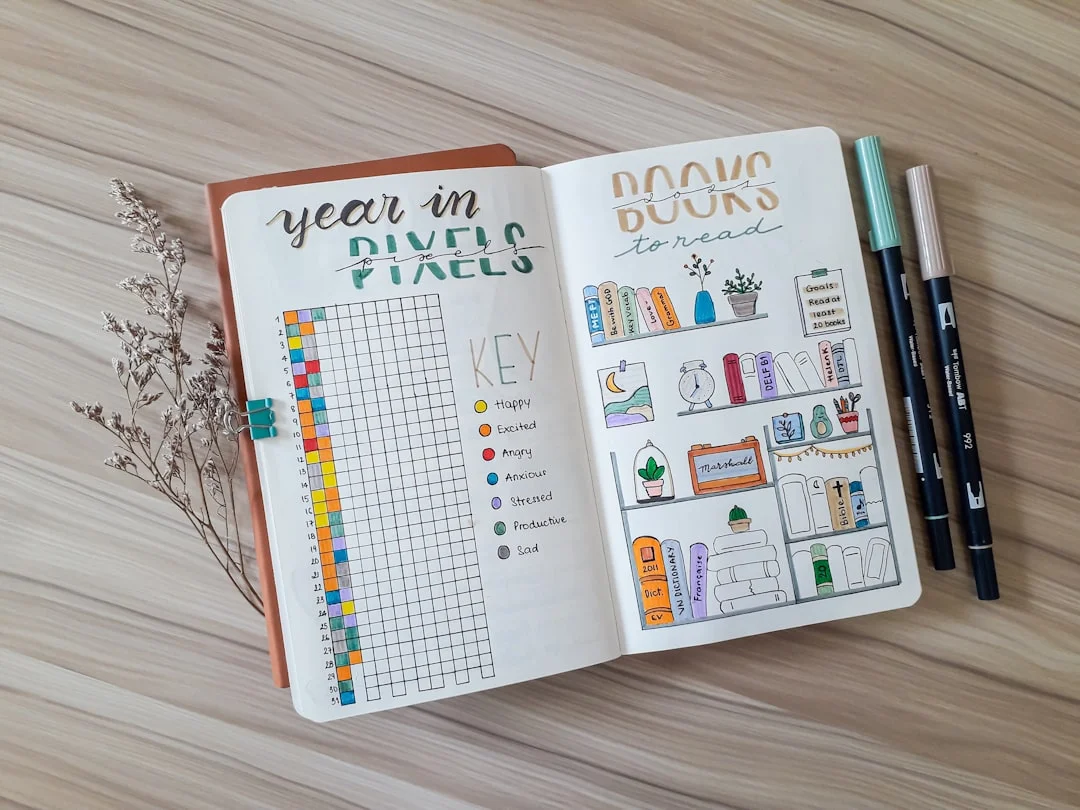
The most common bullet journal spread, and for good reason. A simple grid, one box per day of the month, colour-coded by mood.
Pick five to six colours, one per mood state: deep blue (sad), blue (low), green (okay), yellow (good), orange (great), red (anxious or angry). Keep the key on the same page so you do not forget what the colours mean. Each night before bed, colour in that day's square.
By the end of the month you have a visual map of your emotional landscape. Patterns appear that are invisible day-to-day. Blue streaks around specific events. Red spikes in the week after bad sleep. Green stretches during certain routines. The tracker itself is half the benefit. Being able to show your therapist or GP "this is what my last three months actually looked like" is the other half.
2. The habit tracker
A grid with three to five habits as rows, days as columns. Tick, dot, or fill each box when the habit is done. Our habit tracker ideas post covers which habits are worth tracking.
Keep it to three to five habits maximum. More than that and the tracker becomes a source of guilt rather than data, which is the most common failure mode of mental health bullet journaling.
3. The brain dump
A blank page, or a few blank pages kept toward the back of the notebook, reserved for when thoughts need offloading.
The format is deliberately loose. Bullet points, fragments, words, whatever comes out. You are not building anything. You are clearing space. This is essentially the night journaling brain dump in paper form, and the research behind it is the same. Michael Scullin at Baylor found that writing down unfinished tasks before bed reduced sleep onset by nine minutes. The brain releases its grip on thoughts once it trusts they are captured.
I use mine at two times: 20 minutes before bed when my mind is loud, and during the day when I realise I have been distracted by background worry for an hour. Five to ten minutes of unstructured writing clears most of it.
4. The gratitude log
One line per day, one specific thing. "Grateful for the walk at lunch" not "grateful for health."
Specificity is the whole point. Research on gratitude interventions by Robert Emmons and Michael McCullough showed that listing just five things per week produced a 25% increase in life satisfaction, and specificity in the entries produces stronger effects than generic lists. Our gratitude journal guide covers the format in more depth.
In a bullet journal, this takes up a small corner of a weekly spread. One line per day is enough.
5. The thought record
This is the CBT-based spread and one of the most useful if anxiety or rumination are part of the picture.
Four columns per entry:
- Situation: what happened (factual, neutral)
- Thought: the automatic thought that went through your head
- Evidence: what actually supports or contradicts the thought
- Reframe: a more balanced version
Example:
- Situation: My manager walked past without saying hi
- Thought: She is annoyed with me
- Evidence: She has been fine in meetings this week. She was on her phone when she walked past. I have no actual evidence she is annoyed.
- Reframe: She was probably distracted. I am assuming rejection without data.
Four lines. Three minutes. This is genuine cognitive behavioural therapy-style work, and it is most useful when you catch the anxious thought in real time rather than hours later.
6. The trigger log
A running list of moments when anxiety, low mood, or other difficult emotions spiked, with the context.
Two columns: what happened, what I felt. No analysis at the time.
After a month, you have data. Patterns emerge. Certain people, times of day, kinds of task, or physical states (low blood sugar, poor sleep, dehydration) show up repeatedly. Knowing the patterns is the first step in planning around them.
7. The sleep tracker
Simple grid: date, bedtime, wake time, sleep quality (1-5), any notes. Takes ten seconds each morning.
Over weeks, you notice the correlations between sleep and everything else. The mood tracker and the sleep tracker in the same notebook is often the combination that produces the most actionable self-knowledge.
8. The weekly review
Half a page each Sunday.
- Three wins this week: specific, small is fine
- What drained me: honest, without self-blame
- One thing for next week: a single priority, not a full to-do list
The weekly review is the step that turns daily tracking into actual self-knowledge. Without it, the mood tracker and habit tracker are just data. With it, they become patterns you can act on.
What Should You Leave Out of Your Mental Health Bullet Journal?
A few things that look good on Pinterest and work poorly in practice.
Elaborate decorative spreads. If the spread takes an hour to set up, you will avoid using it. Pretty is the enemy of consistent here. Plain, dated, and filled out is worth more than beautiful and blank.
Too many tracked items. I know I keep repeating this, but it is the single biggest failure mode. Three to five tracked items maximum. Not fifteen.
A thought record you never actually use. Thought records work when you use them in the moment an anxious thought spirals. If you add the spread and never fill it in, it is decoration.
Detailed task lists disguised as mental health work. If the spread is really a to-do list with a mood colour on top, treat it as what it is. Productivity tracking and mental health tracking overlap but are not the same. Do not conflate them.
What Does a Simple Starter Setup Look Like?
If you are building your first mental health bullet journal, here is the smallest useful version.
Pages 1-3: key and setup. The colour code for your mood tracker, the list of habits you are tracking, and the date you started.
First month: one monthly mood tracker (one page), one monthly habit tracker (one page), daily logs (one line per day, together across a few pages), gratitude log (one line per day, small section), weekly review (half a page each Sunday).
Back of the notebook: 20 blank pages reserved for brain dumps.
That is it. You can add thought records, trigger logs, and sleep tracking in month two if month one was sustainable. Adding everything at once almost guarantees abandonment.
Where Mindful fits in
Paper bullet journaling pairs well with a mental health app for consistency. Mindful handles the daily tracking with quick mood check-ins, habit ticks, and a three-minute journal prompt. The app's pattern recognition across weeks surfaces correlations between mood and habits that would take hours of manual bullet journal review to spot.
What the app does not replicate is the slower reflective work of handwriting. Sunday afternoon bullet journal sessions still live on paper in my setup. The daily tracking lives in the app. Neither tool is doing the other's job, and the combination is lower-friction than trying to force paper to handle daily consistency or forcing an app to handle reflective depth.
Start with two spreads
If you have a notebook and twenty minutes, set up the mood tracker and the habit tracker tonight. That is the whole starting point. Everything else you can add later.
Use a plain pen. Skip the brush lettering. Write the word "April" or "May" normally. Colour in the first square.
Two weeks of consistent use will tell you whether this is for you. If it is, you can graduate to the other spreads one at a time. If it is not, you have lost twenty minutes and a page of notebook, which is recoverable.
The bullet journals that work for mental health are ugly and consistent. The pretty ones are often neither. Start ugly. The prettiness, if you want it, will follow once the habit is real.
Free to use, no credit card needed
Try Mindful free →