Habit Tracker Ideas: 30 Worth Tracking (and 10 That Aren't)
Research-backed habit tracker ideas that actually build lasting habits. Plus the common tracking mistakes that make people quit before the habit sticks.
I used to track fifteen habits at once. I tracked zero by day 11.
The first habit tracker I tried had sleep, water, steps, meditation, journaling, reading, stretching, gratitude, screen-free time, vitamins, Spanish practice, strength training, running, cold shower, and mood. Fifteen boxes to tick every single day. I was committed. I was going to fix my whole life at once.
By day three I forgot to drink enough water. By day five I missed the cold shower because I was running late. By day eight I stopped opening the app entirely. By day eleven I had forgotten it existed.
What I learned the hard way is that habit trackers do not fail because you lack discipline. They fail because you are trying to track too many things, or the things you are tracking are not the things that actually matter. This post is everything I wish someone had told me before that first fifteen-habit disaster.
TL;DR
- Habit formation takes an average of 66 days according to Phillippa Lally's UCL research, not 21 as the popular myth claims
- Track three to five habits maximum. More than that and most people abandon the tracker within two weeks
- The best habits to track have a clear yes or no outcome each day. Vague goals like "be present" cannot be tracked
- Never miss twice. Missing one day has almost no effect on long-term habit formation, but missing two in a row triples quit rate
- 30 habits worth tracking plus 10 that waste your time are listed below, organised by category
- A habit tracker is data, not a verdict. Review it weekly to learn, not to judge
What actually makes a habit trackable
Not every goal can live on a habit tracker. The ones that work share three features.
They have a binary outcome. You either did it or you did not. "Drink a glass of water after breakfast" is trackable. "Be more hydrated" is not. "Write one sentence in the journal" is trackable. "Work on self-awareness" is not. If you cannot mark a box without a conversation with yourself about whether it counts, the habit is too vague.
They are small enough to do on your worst day. BJ Fogg at Stanford built an entire methodology around this, called Tiny Habits. The insight is that the version of the habit you design has to survive the days you are sick, exhausted, travelling, or grieving. If it cannot survive those days, it does not survive past month one. That is why "run three miles" fails and "put on running shoes" succeeds. The tiny version gets you to month three, at which point you are often running three miles anyway because you are already there.
They have a clear trigger. Habits that depend on remembering to do them tend to fail. Habits attached to an existing routine tend to stick. The research on implementation intentions by Peter Gollwitzer showed that attaching a new behaviour to a specific moment ("after I pour coffee, I will write one sentence") roughly triples follow-through compared to just setting a general intention.
30 habits actually worth tracking
Organised by category. Pick no more than five total, one or two per category at most.
Physical and body
- Water intake — one glass when you wake, one with each meal. Binary: yes or no to "drank before noon."
- Steps — a daily number that is realistic for your current life, not what Instagram suggests.
- Movement of any kind — walking, yoga, dancing, lifting. Any deliberate movement over ten minutes counts.
- Sleep duration — not quality, just lights-out and wake time.
- No alcohol — if this is something you are working on. Track the yes or no.
- Three real meals — not optimising nutrition, just eating at three actual meal times.
- Sunlight before 10am — fifteen minutes outside in the morning, even on cloudy days.
- Stretching for two minutes — after waking or before bed, not both.
- Strength exercise twice a week — not daily. Strength habits work better as weekly not daily.
- Caffeine cut-off by 2pm — if sleep is the habit underneath this.
Mind and emotion
- One-sentence journal entry — the version of journaling that actually survives a bad week. Our micro journaling guide covers formats.
- Morning mood rating on a 1 to 10 scale — thirty seconds.
- Evening brain dump — whatever is on your mind, onto paper, before bed. Pairs well with night journaling.
- One minute of deep breathing — box breathing, 4-7-8, or any count you will stick to.
- Gratitude note — one specific thing, not three vague things. Specificity is what makes it work.
- Ten minutes of silence — no podcast, no music, no screens. Walk, shower, or sit still.
- Daily emotional check-in — two minutes noticing what you feel.
Mind (learning and focus)
- Ten minutes of reading — anything that is not social media.
- One focus block without your phone — a single 25-minute session with the phone in another room.
- One thing learned today — a single fact, idea, or realisation, written down.
- Thirty minutes on one project — something that is not urgent but is important to you.
- Phone off the bed — a binary habit about where the phone charges at night.
Connection and relationships
- One message to someone you care about — text, voice note, anything real.
- Fifteen minutes of undistracted time with a partner or family member — phone down, eye contact, no second screen.
- Weekly call with a friend you rarely see — tracked once a week, not daily.
Home and environment
- Bed made — takes 45 seconds, changes the feel of the room all day.
- Five-minute tidy — one area, one timer, one round.
- No notifications for the first hour of the day — protected start.
Money and life admin
- Log one expense — not track every expense, just one, to build the noticing habit.
- One small admin task completed — respond to one annoying email, book one thing you have been putting off, pay one bill.
10 habit tracker ideas that waste your time
These show up on every "100 habit ideas" list. They sound good. They do not work.
- Be more present — not trackable. No binary outcome. You are measuring a mood, not a behaviour.
- Meditate 20 minutes daily — too long for most beginners. Starts with good intentions, stops after seven days. Start with two minutes.
- 10,000 steps every single day — the number is arbitrary. If you miss one day it feels like failure even though the daily average is fine.
- No sugar — binary abstinence habits work for some people but often trigger all-or-nothing thinking that makes the tracker a source of shame.
- Work out for an hour — duration-based workout habits fail more often than action-based ones. "Gym clothes on" is a better habit than "hour at the gym."
- Sleep by 10pm — fine in theory, impossible on nights you have plans. Becomes a guilt habit.
- Complete to-do list — you will never finish a to-do list. Tracking completion means tracking failure.
- Read one book per week — weekly scale is too long for a daily tracker. Track "ten minutes read" instead.
- Cold shower every morning — specific, but brittle. One sick day, one hotel with no cold water, and the streak breaks.
- Positive thinking — not measurable, not behavioural, not trackable. Delete it.
The pattern in the failure list: vague outcomes, unrealistic duration targets, and abstinence framings that reward streaks but punish humans.
How to set up a tracker that actually survives
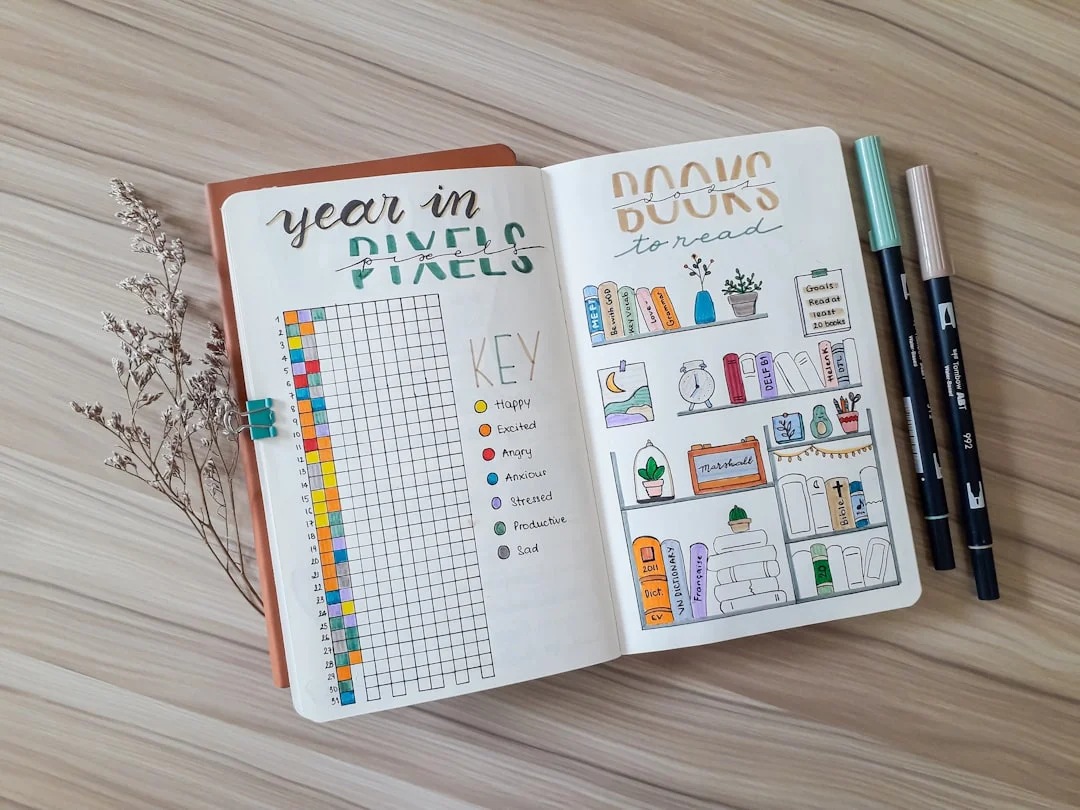
Pick the format you will look at. If you keep a paper notebook already, a bullet-journal-style page works. If you live on your phone, an app-based tracker is better because you see it constantly. The format matters less than how often you look at it.
Use a simple grid. Habits as rows, days as columns. Mark a dot, a tick, or fill in a square. No points systems, no streaks that make you feel bad when they break, no gamification that is actually just designed to keep you in the app.
Place it somewhere you cannot avoid. This is the single biggest predictor of whether a tracker survives the first month. On the fridge. Next to the kettle. As a phone widget. Pinned above the desk. The tracker has to be in your daily eyeline, not buried three taps deep in an app.
Review it every Sunday. Ten minutes. Look at the grid and notice patterns. Which days did you miss and why. Which habits are thriving and which are always blank. Do not judge. Just notice. If a habit is always blank after three weeks, either the habit is wrong, the trigger is wrong, or the timing is wrong. Adjust it or drop it.
Never miss twice. This is the rule that actually matters. Research suggests that missing one day has very little effect on long-term habit formation, but missing two in a row roughly triples the chance of quitting. If you missed yesterday, today is the critical one. Small version, ten-second version, whatever. Just mark the box.
What to track alongside the habits
A habit tracker on its own tells you what you did. Pairing it with a mood or energy rating tells you what those habits are actually doing for you.
The simplest way is to add one extra row to the tracker: a daily 1-to-10 mood rating. After four weeks, you will start to see correlations that would take years to notice otherwise. Higher moods on days you slept more than seven hours. Lower moods on days you skipped movement. These correlations are what turn a habit tracker from a to-do list into actual self-knowledge.
If you are already using a mood journaling practice, pair it with the tracker and the insights compound. The habits give you the causes. The mood gives you the effects. Seeing them side by side is where behaviour change becomes intentional rather than aspirational.
Where Mindful fits in
The trackers I used to print on paper now live in Mindful. The app pairs daily habit ticks with mood check-ins and guided journal prompts, then pulls out the patterns across weeks. Higher mood on days you walked in the morning. Lower mood on days you skipped breakfast. Connections I knew intellectually but kept forgetting in the moment, shown back to me in my own data.
The tracker is only three taps. The mood rating takes ten seconds. The journal entry is optional on days you do not feel like writing. The design target was "the version of a habit tracker that survives a bad Tuesday," and that is what we built.
It is free to start, and the whole thing is designed to take three minutes a day. Two weeks is enough to see whether it fits how you actually live.
Start with three
Pick three habits from the list above. Not seven. Not fifteen. Three.
Make each one small enough that you could do it on your worst day of the month. Attach each one to something you already do reliably. Mark the box when you do it, leave it blank when you do not. Review on Sunday.
Do this for 66 days, which is the actual average time a new habit needs. Expect to miss some days. Do not miss two in a row. At the end of two months, you will have three new habits that feel automatic, and the tracker will start to feel less like a daily chore and more like a mirror that tells you what kind of week you just had.
Three is the number. Not fifteen. Start tonight.
Free to use, no credit card needed
Try Mindful free →